Repair Is the Real Legacy: Breaking the Cycle of Shame
My teenage daughter and I were having a wonderful Sunday together. We had gone to a sprinkler park and the zoo, and on the way home she asked if we could stop at a waterfall in a nearby nature reservation. She already had her bathing suit on, it was along our route, and it seemed like a perfect way to end the day. She was so excited that I didn't want to disappoint her. By the end of the afternoon, we were both exhausted and heartbroken.
My daughter has autism, and she can become overstimulated quickly. At the waterfall, she threw a rock that almost hit another child, and I knew it was time to leave. But she refused to go home. She cried, screamed, spat at me, and tried to run back toward the waterfall. I had to carry her for part of the walk before setting her down because I couldn't safely carry both her and everything we had with us. Other families stopped to watch. I found myself explaining to strangers that she was my daughter, that she has autism, and that I was simply trying to get her home safely. It was one of those parenting moments that feels as though it lasts forever.
The whole time this was happening, I was blaming myself. I should have known better. We had already had a wonderful day. Why did I feel the need to add one more activity? I had brought my daughter into the woods, far from the car, late in the day when she is most likely to become overstimulated. I had no exit strategy. As we made our way back to the car, my thoughts became increasingly harsh. I'm so stupid. This is all my fault. What kind of father does something like this? In that moment, I wasn't merely regretting a decision. I had confused a bad decision with a bad identity. It wasn't, "I made a mistake." It was, "I am the mistake."
“It wasn't, ‘I made a mistake.’ It was, ‘I am the mistake.’”
And yet, something beautiful happened on the ride home. She became quiet. She apologized for her behavior. I pulled the car over, apologized for bringing her to the waterfall, and told her that I had set her up for failure by asking too much of her that day. Then she hugged me. We both wanted the same thing. We both wanted the day back.. I finally brought her home safely. By the time we walked through the front door, I was physically and emotionally exhaused.
After she calmed down, she took a bath. When she finished, I noticed she had submerged the entire bottle of soap, and most of it was used during hter bath. This wasn't the first time it had happened. My patience was gone. I raised my voice. She apologized. But instead of accepting her apology, I responded, "I don't believe you. That is a lie." I told her that if she were truly sorry, she would stop doing it.
“We both wanted the same thing. We both wanted the day back.”
Almost immediately, her face changed. "I hate myself." I'm so stupid.” Then she looked at me and quietly said something that stopped me in my tracks. “I’m scared.”In that moment, I realized she wasn't just talking about the soap.
“Why are you scared, ” I asked her.
"I'm scared you'll say you hate me." Those words pierced my heart. Not because I hate my daughter—I love her more than words can express—but because, in that moment, she believed that my love might disappear because of a mistake. In that moment, I realized that the shame I carried wasn't staying inside me anymore. It had begun spilling onto the person I loved most.
Then something unexpected happened. Almost instantly, I found myself thinking the very same words she had just spoken."I hate myself. I'm so stupid." It was as if her inner critic had awakened my own.
“…the shame I carried wasn't staying inside me anymore. It had begun spilling onto the person I loved most.”
When Behavior Becomes Identity
As parents, we often want to correct behavior. That is part of our responsibility. But somewhere in the conversation, I stopped addressing the behavior and started attacking something much deeper. Instead of saying, "We need to figure out how to stop this from happening again," I questioned her sincerity. To a child, that can easily become something much larger. Not:"I made a mistake,” but “I am the mistake."
The heartbreaking part is that I realized I had done the very same thing to myself. I wasn't thinking, I handled that poorly." I was thinking, "I'm a terrible father." The same pattern had repeated itself in both of us within seconds.
Repair Is the Real Legacy
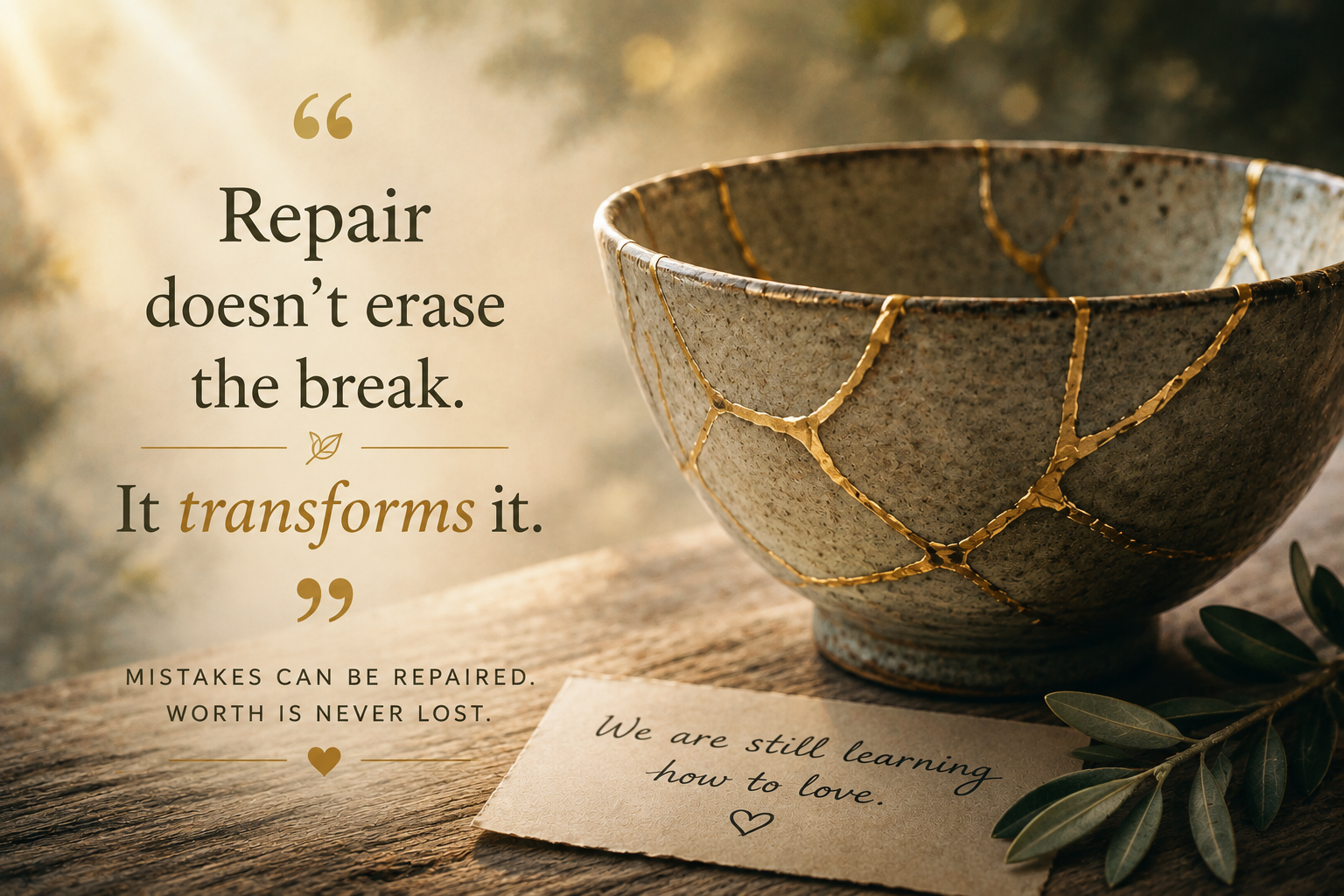
Parenting is not about never raising your voice. It is not about never making mistakes. Every relationship experiences moments of rupture. What matters most is whether we return.It reminds me of kintsugi, the Japanese art of repairing broken pottery with gold. Rather than hiding the cracks, kintsugi honors them as part of the object's history. The vessel can never be exactly as it was before, yet the repair becomes part of its beauty. The repair doesn't erase the break; it transforms it. I believe parenting is much the same. It's about whether we return, whether we apologize, whether we reassure our children that our love is bigger than their mistakes—and bigger than our own. Later, I told my daughter, "I was frustrated about the soap, but I shouldn't have said I didn't believe you. I love you, and nothing you do will make me hate you." We can work on changing the behavior together."
“…perhaps breaking generational cycles isn't about becoming the perfect parent. It is about learning, over and over again, to separate behavior from identity.”
I need to hear those words, too. Because the voice that says, “I hate myself." is not wisdom. It is an old wound. And perhaps breaking generational cycles isn't about becoming the perfect parent. It is about learning, over and over again, to separate behavior from identity. To remember that relationships can be repaired. And that neither our children nor we lose our worth because we are still learning how to love.
The Inner Critic We Pass Along
One of the central ideas of Vedantic philosophy is that beneath our conditioned personalities lies our true nature—whole, unchanging, and inherently worthy. That idea has always resonated with me because it echoes what I've observed in myself and in the people I've worked with: beneath fear, shame, and protective behaviors, there remains a healthy core that is never completely lost. Last night reminded me how easy it is to lose sight of that truth. Not only in our children—in ourselves. When my daughter said, "I hate myself," I wasn't just hearing her voice. I was hearing the younger version of myself who learned to believe that mistakes threatened love and belonging. That realization was painful. But it was also illuminating. Because cycles are rarely broken by pretending they don't exist. They are broken when we recognize them.
The Burden of Perfection
Later that evening, after everything had settled down, I found myself asking a different question. Why was I so deeply triggered by this incident? At first, I thought the answer was simple: I know what shame feels like, and I never want my daughter to carry the same burden. But as I sat with that question a little longer, another one emerged. How has needing to be the perfect father become a burden on me?
The answer surprised me. I had placed enormous pressure on myself never to lose my patience, never to make a parenting mistake, and never to resemble the kind of parenting I experienced growing up. Somewhere along the way, I had quietly created another impossible standard for myself. The harder I tried to become the father I never had, the more terrified I became of making an ordinary human mistake. Perfection had become its own prison.
I began to wonder if what I really needed was permission to be an imperfect father—not because shaming is acceptable, but because healing doesn't come from pretending we'll never fail. It comes from recognizing when we have, taking responsibility, repairing the relationship, and returning with greater awareness.
“Perfection had become its own prison.”
That is the work that has transformed my own life. Through years of deep self-reflection, and learning to approach my own wounds with curiosity instead of condemnation, I've begun to recognize the old stories that still shape my reactions. Rather than allowing shame to have the final word, I've learned to ask what it is trying to teach me.
Those are the same kinds of questions I now help others explore. Whether through a story, a coaching conversation, or a guided visualization, my hope is always the same: to help people discover that they are more than the shame they carry, more than the mistakes they've made, and more than the painful stories they've inherited. Because when we begin to see the divine seed within ourselves, we naturally begin to see it in our children, our partners, and the people around us.
That's where new legacies begin.
A New Legacy Begins Here
If this story resonated with you, you're not alone.
Whether you're a parent, a partner, or someone still carrying the wounds of childhood, healing begins the moment we stop confusing our mistakes with our identity.
That's why I wrote Unbroken Legacy: The Divine Seed and why I offer Jungian life coaching—to help people reconnect with the healthy, whole self that exists beneath shame, fear, and inherited beliefs.
As a first step, I'd love to offer you a free guided meditation designed to help you reconnect with your own inner wisdom and begin cultivating a new emotional legacy.